- Legal test
- Individually trained work or tasks directly related to a disability
- Not a task
- Comfort, emotional support, companionship or crime deterrence alone
- Who can train
- A professional program or the handler; the ADA doesn't require professional training
- Proof required in public
- None; staff may ask only two questions
ADA definition of work or tasks
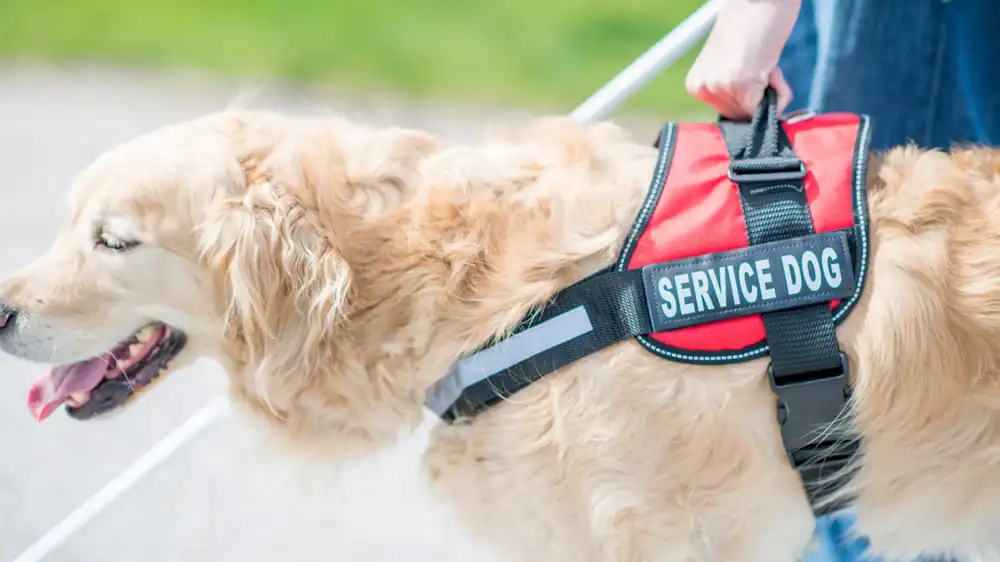
The Americans with Disabilities Act (ADA) defines a service animal as a dog individually trained to do work or perform tasks for a person with a disability, including a psychiatric or other mental disability. The federal regulation adds that the work or tasks must be directly related to the person's disability.
The regulation gives examples, and two speak directly to mental health: retrieving items such as medicine or a phone, and helping people with psychiatric and neurological disabilities by preventing or interrupting impulsive or destructive behaviors. The Department of Justice also lists calming a person with PTSD during an anxiety attack and reminding a person to take prescribed medication as examples of qualifying work.
A task is a specific, trained behavior your dog performs reliably, either on cue or in response to something it has learned to notice. It does something concrete for you that you have trouble doing for yourself because of your disability.
Why comfort isn't a task
Many dogs make their people feel calmer just by being there. That matters, but the ADA is explicit: emotional support, well-being, comfort or companionship does not count as work or a task, and neither does the crime-deterrent effect of a dog's presence.
The Justice Department draws the line with an example. A dog whose mere presence provides comfort is not a service animal. A dog trained to sense that an anxiety attack is about to happen and take a specific action to help you avoid it or lessen it can be. The difference is training and a defined response.
If your dog helps you emotionally but hasn't been trained to do something specific, an emotional support animal (ESA) is likely the more accurate description. ESAs can be recognized in housing under the Fair Housing Act, but they don't have ADA public access rights, and we don't issue ESA letters.
Common PSD tasks
Each task below has its own page covering what it is, which symptoms it can help with, how dogs are usually trained for it, and how to describe it accurately.
- Alerting to anxiety: noticing early signs and nudging or pawing to interrupt them
- Deep pressure therapy: lying across your lap or leaning against you on cue
- Interrupting self-harm: breaking up repetitive or harmful behaviors with a trained response
- Nightmare interruption: waking you from a nightmare with nudging, licking or turning on a light
- Grounding during dissociation: giving steady physical input to help you return to the present
- Medication reminders: alerting you at a set time, often paired with a phone alarm
- Room search: entering a space ahead of you and returning on cue
- Blocking and creating space: positioning its body to give you room in crowds
- Guiding to an exit: leading you to a door, your car or another familiar place
- Retrieving items: bringing a phone, medication pouch or water when you need it
How PSD tasks are trained
The ADA doesn't require professional training, and you are allowed to train your own dog. Many people work with a qualified trainer, especially for tasks tied to a crisis or to subtle cues. A dog also needs solid foundation skills, such as house training, focus on the handler and calm behavior in public, before task work is useful in daily life.
We recommend reward-based (positive reinforcement) methods. The American Veterinary Society of Animal Behavior recommends reward-based training for all dogs and advises against aversive tools and techniques. Our task pages describe training in general terms only; your trainer should tailor the plan to you and your dog.
How to describe your dog's tasks
When it isn't obvious what your dog does, staff at a business may ask only whether the dog is required because of a disability and what work or task it has been trained to perform. You don't have to name your diagnosis, show papers or have your dog demonstrate. A short, plain answer works, such as “He's trained to interrupt panic attacks.”
A psychiatric service dog letter is not needed for public access and doesn't grant public access. A letter is mainly useful for housing requests, where providers may ask for reliable documentation of a disability-related need when it isn't obvious. During your evaluation with a licensed clinician, be ready to explain which symptoms affect you and what your dog does in response. Our clinician decides whether a letter is appropriate; we never promise one.